Real-Time Buying Signals: Know Which Accounts Are Ready to Buy
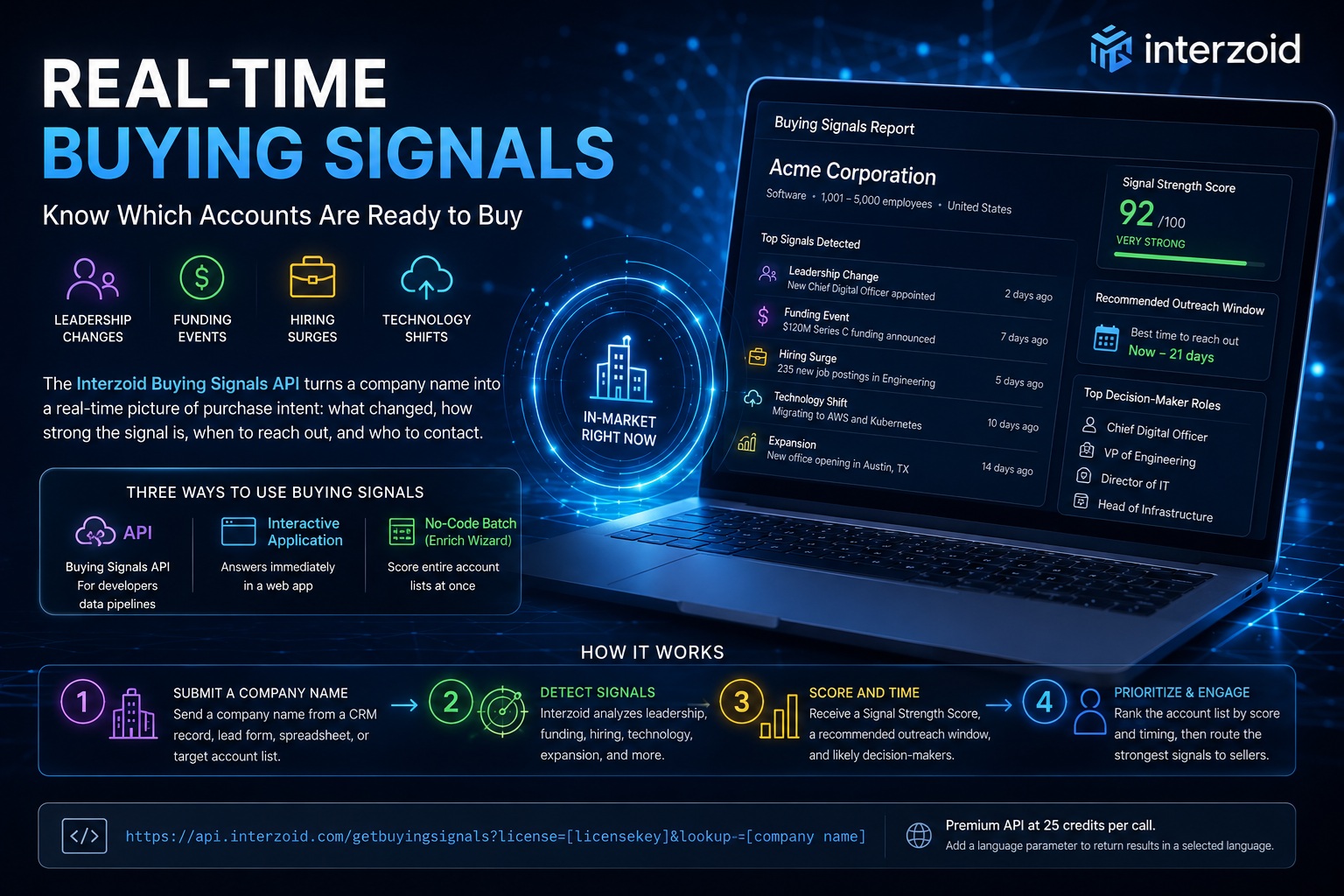
Every sales team has the same problem. The account list is long, the selling hours are short, and the accounts that are actually ready to buy look exactly like the ones that are not. A new executive arrives, a funding round closes, a hiring surge begins, or a platform migration gets underway, and unless someone on the team happens to notice, the moment passes and a competitor engages first.
The Interzoid Buying Signals API surfaces those moments in real time. Provide a company name and receive a structured view of the organizational changes that indicate a company is in-market right now, along with a Signal Strength Score, a recommended outreach window, and the decision-maker roles most relevant to what was detected. It is available three ways: as a REST API for developers and data pipelines, as an interactive web application for anyone who wants answers immediately, and in a no-code batch mode for scoring entire account lists at once.
Buying Signals API | Interactive Application | No-Code Batch (Enrich Wizard)
The Challenge: Intent Is Invisible in the CRM
A CRM record tells you who a company is. It does not tell you what is happening inside that company this quarter. The events that create buying windows, such as a newly hired Chief Digital Officer, a Series C, three hundred open engineering roles, a cloud migration, or a new facility under construction, live in press releases, job boards, funding trackers, technology registries, and news coverage. None of that is in the record.
Sellers try to close the gap with alerts, saved searches, and manual research, one account at a time. That approach does not scale past a handful of top-tier targets, it produces inconsistent results from one rep to the next, and it tends to surface signals days or weeks after they appear. Meanwhile, the rest of the account list is worked in alphabetical order.
Real-time buying signals change the order of operations. Instead of researching accounts to find intent, the intent finds the seller: every account can be scored, ranked, and timed programmatically, on a schedule or on demand, so attention goes to the companies most likely to buy right now.
How the Buying Signals API Works
The API takes a single input, a company name, and applies advanced AI analysis across leadership databases, funding trackers, job boards, technology registries, and news sources. The result is a structured, field-by-field summary of purchase intent that can be appended directly to a CRM record, a marketing list, or a target account spreadsheet.
Submit a Company Name
Send a company name from a CRM record, a lead form, a spreadsheet, or a target account list.
Detect Signals
Interzoid analyzes leadership, funding, hiring, technology, expansion, pain point, and budget indicators.
Score and Time
Receive a Signal Strength Score, a recommended outreach window, and likely decision-makers.
Prioritize and Engage
Rank the account list by score and timing, then route the strongest signals to sellers.
This is a premium API at 25 credits per call. A language parameter can also be added to return results in a selected language for international sales teams.
What a Buying Signals Response Contains
Each response is organized into signal categories, followed by a score, a timing recommendation, and a decision-maker map. Every field is designed to be appended to a record and read at a glance by a seller.
| Field | What It Tells You |
|---|---|
| CompanyName, Industry, CompanySize | Identity and context for the company being analyzed. |
| LeadershipChanges | Recent C-suite and VP-level hires, departures, or role changes, often the first sign of a new vendor evaluation. |
| FundingEvents | Recent funding rounds, IPO activity, debt financing, or investment events that unlock budget. |
| HiringSignals | Notable hiring patterns, new departments, or surge hiring in specific functions. |
| TechnologyChanges | Platform migrations, tech stack changes, and digital transformation initiatives underway. |
| ExpansionSignals | New offices, geographic expansion, M&A activity, or market entry indicators. |
| PainPointIndicators | Publicly visible challenges that suggest urgency to buy solutions. |
| BudgetIndicators | Budget availability, fiscal year timing, and earnings guidance. |
| SignalStrengthScore | Overall buying propensity based on the aggregate weight and recency of detected signals. |
| RecommendedTiming | The suggested outreach window and the reasoning behind it. |
| KeyDecisionMakers | Likely decision-maker titles and roles relevant to the detected signals. |
Three Ways to Put Buying Signals to Work
The same intelligence is available in whichever form fits the job at hand: developers integrate the API, individual sellers and analysts use the interactive application, and operations teams score whole account lists with the no-code batch tool.
REST API
A single HTTPS call returns structured JSON ready to write back into CRM fields, enrichment pipelines, marketing automation, or custom applications. Trigger it when a lead is created, run it on a nightly refresh, or expose it inside your own tools. Works with any language, and a cURL example is on the product page.
Interactive Application
A browser-based application for anyone who needs an answer right now, with no code and no setup. Type a company name and receive a formatted buying signals report on screen: ideal for sellers preparing for a call, SDRs researching a new target, or anyone evaluating the API before integrating it.
No-Code Batch Mode
The Enrich Wizard runs the Buying Signals API across an entire CSV or TSV file of companies on Interzoid's parallel-processing cloud platform. Upload a target account list, select the API, and download a file with signal categories, scores, timing, and decision-makers appended to every row, typically in minutes.
Matching Signals to Sales Actions
Each signal category maps to a specific reason a company might be evaluating vendors, and therefore to a specific sales motion. The score and timing fields tell the seller how urgent that motion is.
| Signal Category | What It Usually Means | Sales Action |
|---|---|---|
| Leadership Changes | A new executive is setting a roadmap and choosing a vendor stack. | Reach the new leader early, before relationships are established. |
| Funding Events | Fresh capital is being deployed against growth initiatives. | Position around the stated use of funds. |
| Hiring Signals | A function is scaling and will need tooling to support it. | Sell to the team being built, not the team that exists today. |
| Technology Changes | A migration or platform decision is in progress. | Enter the evaluation while options are still open. |
| Expansion Signals | New locations, markets, or acquisitions are creating new requirements. | Frame the offer around the expansion timeline. |
| Pain Point and Budget Indicators | There is a visible problem and the means to solve it. | Lead with the problem, and align to the fiscal calendar. |
| Signal Strength Score and Timing | How strong the aggregate intent is and when the window is open. | Rank the account list and sequence outreach accordingly. |
Practical Workflows for Real-Time Buying Signals
Once buying signals are appended to your records, they slot into workflows revenue teams already run. A few examples:
- Score the entire target account list: upload the list to the Enrich Wizard, run the Buying Signals API in batch, and sort the output by Signal Strength Score and Recommended Timing.
- Enrich new leads as they arrive: call the API from the lead-creation event in your CRM and route high-scoring accounts straight to a seller instead of a nurture sequence.
- Refresh intent on a schedule: re-run the API monthly or quarterly across open opportunities so timing recommendations stay current as conditions change.
- Prepare for the call: before a meeting, open the interactive application, look up the account, and walk in knowing what changed and who is likely deciding.
- Build trigger-based campaigns: segment marketing audiences by signal category, such as new-executive or funding-event accounts, and tailor messaging to the trigger.
- Combine with other enrichment: pair buying signals with Get Business Info for firmographics and Get Executive Profile to turn decision-maker titles into named contacts.
Why Real-Time Buying Signals Matter for Revenue
Timing is the variable most sales processes leave to chance. The same pitch to the same account can win or lose depending on whether it lands during an active evaluation or six months after the decision was made. Buying signal data moves timing from luck to process.
Companies using buying signal data typically see a 2-3x improvement in pipeline conversion rates, because sellers spend their hours on accounts showing genuine, current propensity to buy rather than working the list in arbitrary order.
- Prioritization: a single score ranks every account by real-world intent.
- Timing: a recommended outreach window replaces guesswork about when to engage.
- Relevance: signal categories give sellers a specific, current reason to reach out.
- Targeting: decision-maker roles point outreach at the right stakeholders.
- Coverage: batch mode scores the whole list, not just the accounts someone had time to research.
- Productivity: hours of manual monitoring replaced by an API call, an app lookup, or a file upload.
Getting Started
Getting started takes a few minutes, whichever path you choose.
- Register for an Interzoid API account and get an API key.
- Try a lookup in the interactive application to see the full response for a company you know.
- For a list of accounts, upload a CSV or TSV to the no-code Enrich Wizard and run the Buying Signals API in batch.
- For applications and pipelines, integrate the Buying Signals API directly and append the results to your records.
- Rank, route, and engage based on Signal Strength Score and Recommended Timing.
Related Interzoid Data Enrichment APIs
Buying signals are most powerful alongside the rest of the account picture. These APIs complement the Buying Signals API and are also available in the interactive tools and the Enrich Wizard:
Knowing which accounts are ready to buy no longer has to depend on alerts, saved searches, or a rep who happened to read the right press release. The Interzoid Buying Signals API detects leadership changes, funding events, hiring surges, technology shifts, expansion moves, pain points, and budget indicators for any company, then distills them into a score, a timing recommendation, and a decision-maker map.
Whether you integrate the API into your pipeline, look up an account in the interactive application, or score an entire list in no-code batch mode, real-time buying signals give revenue teams a practical way to spend their time where it will convert.
Get an API Key | Try the Interactive App | Score a List in Batch | View the API