Simplifying Entity Resolution with Interzoid Data Matching APIs
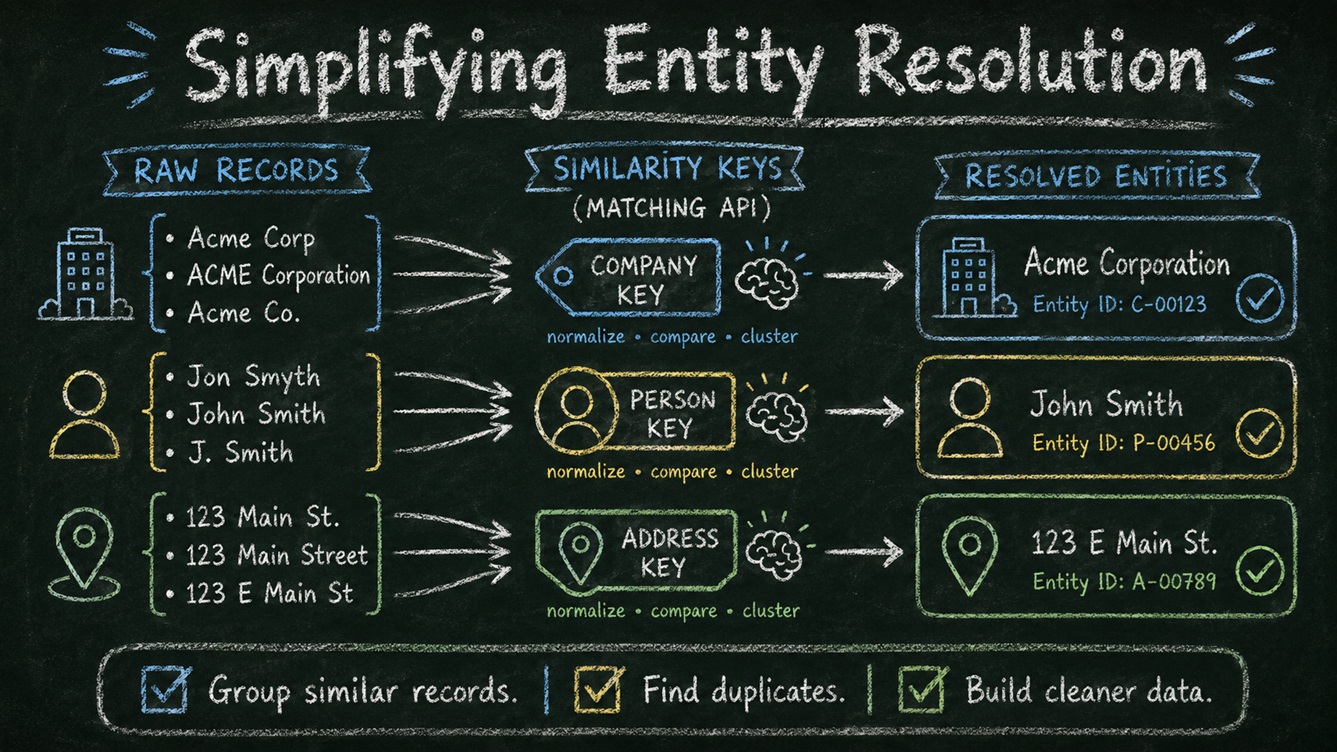
Entity resolution is the process of determining when different records actually refer to the same real-world entity. That entity might be a company, an individual, a location, a customer, a supplier, a property, a business contact, or a combination of several identifying fields.
In theory, this sounds straightforward. In practice, business data is full of variation: spelling differences, punctuation changes, abbreviations, acronyms, legal suffixes, casing differences, address formatting differences, missing fields, and inconsistent naming conventions. Traditional exact-match logic often misses these relationships because it compares only the surface text.
Interzoid simplifies entity resolution by generating AI-powered Similarity Keys that group similar records together. Instead of requiring every value to be perfectly standardized before matching, Interzoid's matching APIs identify values that likely represent the same underlying entity and return a consistent key that can be used for grouping, deduping, fuzzy searching, dataset matching, and entity consolidation.
Get an Interzoid API Key | Explore the API Directory | Create a Match Report
The Challenge: Entities Rarely Look the Same Across Systems
Organizations often maintain the same entity across multiple systems: CRM, ERP, marketing automation, analytics platforms, customer support tools, procurement systems, spreadsheets, data warehouses, and partner data feeds. The problem is that the same real-world entity often appears differently in each location.
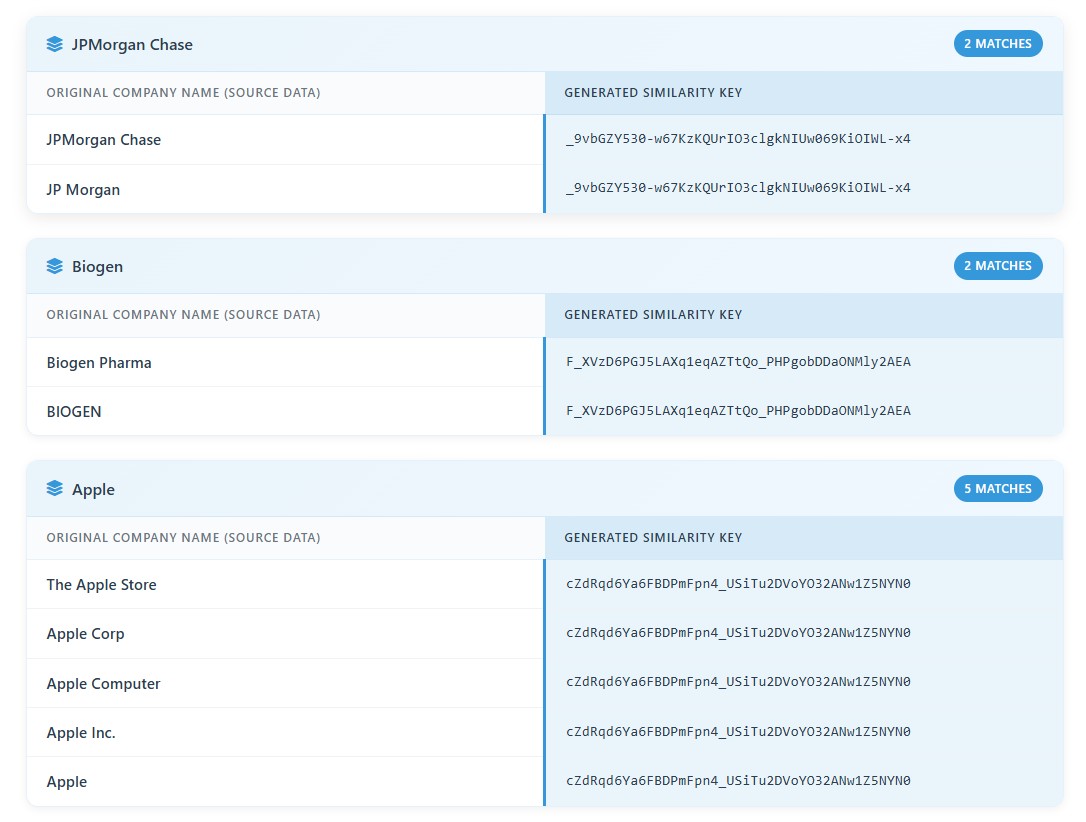
A company may appear as Apple, Apple Inc., Apple Computer, or The Apple Store. A bank may appear as JPMorgan Chase in one file and JP Morgan in another. A university may appear by its full name in one place and by an acronym in another. Exact-match joins treat these as different records, even when business users understand they are related.
Entity resolution bridges that gap by identifying when inconsistent representations point to the same underlying entity. This helps organizations reduce duplicates, improve analytics, unify customer and vendor records, strengthen master data, and prepare cleaner datasets for AI, automation, and operational workflows.
How Interzoid Simplifies Entity Resolution
Interzoid's approach centers on the generation of Similarity Keys. A raw data value is sent to an Interzoid matching API. The API evaluates the value using AI models, machine learning, specialized algorithms, and knowledge bases, then returns a generated key. Records that produce the same Similarity Key can be grouped together as likely matches.
Submit Raw Values
Send company names, individual names, addresses, or combined fields to the appropriate API.
Generate Similarity Keys
Interzoid returns keys designed to group similar representations of the same entity.
Cluster Matches
Sort, group, join, or filter by Similarity Key to identify match candidates.
Resolve Entities
Use clustered records to dedupe, merge, standardize, enrich, or consolidate entity data.
Example: Company Name Entity Resolution
A company-name match report shows how Similarity Keys can expose relationships that exact-match logic would miss. In a match report, each cluster groups records that Interzoid's matching engine has identified as the same underlying company entity. The source values may differ in spelling, casing, punctuation, legal suffixes, or abbreviations, but the generated Similarity Key remains the same within the cluster.
| Entity Cluster | Source Data Variations | Resolution Concept |
|---|---|---|
| Apple | Apple, Apple Inc., Apple Computer, Apple Corp, The Apple Store | Different representations can be grouped under one resolved company entity. |
| JPMorgan Chase | JPMorgan Chase, JP Morgan | Spacing and naming variations can still resolve to the same organization. |
| San Diego State | San Diego State, SDSU | Acronyms and full names can be grouped as related entity representations. |
| Ford Motor Company | The Ford Motor Corporation, FORD INC., Ford Motors | Legal suffixes and common name variations can be handled as part of entity matching. |
This is the practical value of entity resolution: instead of manually inspecting every variation, teams can use Similarity Keys to automatically surface likely duplicates and related records for review, consolidation, matching, or downstream processing.
Company Name Entity Match Report
The Seven Interzoid Data Matching APIs for Entity Resolution
Entity resolution often requires more than one kind of matching. Sometimes a company name alone is enough. Other times, the best match signal comes from an address, an individual name, or a composite key made from multiple fields. Interzoid provides matching APIs that support these different entity-resolution patterns.
| Data Matching API | Entity Resolution Use Case | How It Helps |
|---|---|---|
| Company Name Matching API | Resolve organization, account, vendor, supplier, and prospect names. | Groups inconsistent company and organization names using generated Similarity Keys. |
| Individual Name Matching API | Resolve person records, contacts, customers, leads, patients, members, or constituents. | Identifies likely matches across variations in individual names, spelling, casing, and formatting. |
| US Street Address Matching API | Resolve address records in customer, property, delivery, billing, or operational datasets. | Clusters similar street address values even when formatting and abbreviations vary. |
| Full Name and Address Matching API | Resolve individual identity records using both person name and address context. | Creates a composite match key that can be more precise than name-only matching. |
| Company and Address Matching API | Resolve business-location records, branch records, vendors, facilities, and account-location data. | Combines company name and address to identify matching business entities at a location level. |
| Company and Full Name Matching API | Resolve contact records where both a company and associated person are available. | Improves matching for CRM, sales, marketing, customer success, and business contact datasets. |
| Global Address Matching API | Resolve international address records across global customer, vendor, facility, and location data. | Supports worldwide address matching where country-specific formatting can vary significantly. |
Choosing the Right Matching Strategy
A key advantage of Interzoid's approach is flexibility. Entity resolution does not always have to rely on one field. The right API depends on the data available and the level of precision required.
Single-Field Matching
Use company name, individual name, or address matching when one field is the primary identifier and the goal is to cluster similar values quickly.
Composite Matching
Use combined-field APIs when two fields together provide a stronger identity signal, such as company plus address or full name plus address.
Global Matching
Use global address matching when your data spans countries, regions, and address formats that require broader international handling.
For example, if two records have similar company names but different addresses, they may represent different branches or locations. If two records have both similar company names and similar addresses, the match confidence for the same business location becomes stronger. Likewise, a full name may be common on its own, but full name plus address can provide a more precise composite identity key.
Entity Resolution by API or No-Code Match Report
Interzoid matching can be used in two complementary ways. Developers can call the APIs directly from applications, websites, data pipelines, ETL/ELT jobs, data products, AI workflows, or internal business systems. Business and data teams can also use no-code match-report workflows to process complete CSV or TSV datasets through a browser-based interface.
API Integration
Generate Similarity Keys one record at a time inside applications, data pipelines, workflows, databases, and operational systems.
No-Code Match Reports
Upload datasets and generate clustered match reports for company names, individual names, and addresses without writing code.
Full Dataset Processing
Process entire files or tables to append Similarity Keys, identify duplicates, and prepare resolved entity groups for downstream use.
Practical Entity Resolution Workflows
Once Similarity Keys are generated, they can be used in familiar data workflows. The keys provide a practical bridge between raw inconsistent data and higher-quality resolved records.
- Deduplicate one dataset: generate Similarity Keys, sort by key, and review clusters where multiple records share the same key.
- Match across datasets: generate keys for both files or tables, then join or compare records with matching keys.
- Create a golden record workflow: identify clusters, select the best surviving record, and consolidate useful attributes from related records.
- Improve search and discovery: use Similarity Keys as part of a fuzzy-search mechanism to find related records that exact search misses.
- Prepare data for AI and analytics: reduce duplicate entities before feeding records into dashboards, models, agents, or reporting systems.
Why Entity Resolution Matters for Better Data ROI
Duplicate, inconsistent, and fragmented entity data reduces the value of business systems. Sales teams may see multiple versions of the same account. Marketing campaigns may target duplicates. Procurement teams may miss vendor consolidation opportunities. Analytics dashboards may overcount customers, suppliers, facilities, or contacts. AI systems may produce less reliable results when the underlying entities are not resolved.
By simplifying entity resolution, Interzoid helps organizations make existing data more accurate, more usable, and more valuable. Similarity Keys provide a fast and scalable way to identify matching records across files, systems, and workflows, helping teams move from inconsistent raw data to resolved entity groups that can support better decisions.
- CRM: consolidate duplicate accounts, contacts, and customer records.
- MDM: support master data and golden record initiatives with clustered match candidates.
- Analytics: reduce duplicate counts and improve the reliability of reporting.
- AI readiness: provide cleaner entity-level data for models, agents, and automated workflows.
- Operations: improve vendor, supplier, facility, customer, and location data consistency.
Getting Started
Getting started with Interzoid entity resolution is straightforward. Choose the matching API that aligns with your data, generate Similarity Keys, and use those keys to group, join, review, or consolidate matching records.
- Register for an Interzoid API account and get an API key.
- Choose the matching API that best fits your entity-resolution use case.
- Call the API directly, or use the no-code Match Wizard to process a file.
- Group records by Similarity Key to identify likely matching entities.
- Use the resulting clusters for deduplication, matching, golden record workflows, analytics, AI readiness, or operational cleanup.
Featured Interzoid Data Matching APIs
Explore these Interzoid Data Matching APIs to build practical entity-resolution workflows:
Entity resolution does not have to be a slow, manual, or overly complex data engineering problem. With Interzoid's AI-powered Similarity Keys, organizations can identify records that refer to the same underlying entity even when the source values are inconsistent, abbreviated, misspelled, or formatted differently.
Whether you are resolving company names, individual names, addresses, business locations, contact records, or global address data, Interzoid's matching APIs provide a practical foundation for cleaner data, better matching, stronger analytics, improved AI readiness, and higher ROI from the data your organization already uses every day.
Get an API Key | Create a Match Report | Explore Data Matching APIs